


Sequel-ology: A "Fantasia" Case Study
- Kelly McDonnell
- Jun 5, 2025
- 11 min read


I guess we’re doing sequels these days. Or follow-ups. Or reboots. Or reimaginings.
But it’s not that bad. Studios have always been doing sequels that make us all go, “Who asked for that?”
Take the Walt Disney Company, for example. In the ‘90s, about 15 movies of the studio’s 81-film slate were sequels/adaptations of TV shows - most were direct to video. But that’s about on par with the system in general that decade: of the top 50 grossing films in the '90s, six were sequels. Every year that decade, except for two, there was at least one sequel in the top 10 grossing films worldwide.
But looking at the box office as of recent … there seems to be an itch that we’re scratching, really hard. Like, it’s bleeding.
Not even 15 years ago, sequels topping the domestic box office was still consistent with the 90s, if trending upwards - 2006, 2008 and 2009 each had 4 sequels in the top 10, 2007 had 5; but come 2011, 9 of the top 10 grossing films were sequels. In 2019, 5 of the top 10 films were sequels - if we include remakes/reboots, it’s 8 out of 10. In 2022, 9 of the top 10 were sequels, but if we include reboots - in that year, The Batman starring Robert Pattinson - all 10 films atop the box office, domestically, were sequels or reboots.
Some sequels turn out better than others - i.e. Frozen II and Spider-Man: No Way Home. Others kind of happen and keep happening with muted, if not consistent, returns - i.e. Jurassic World: Fallen Kingdom and Fantastic Beasts: The Crimes of Grindelwald (both films reached the top 10 worldwide in 2018, 2 of the 6 sequels to top that year).
I’m not trying to diagnose why Hollywood is in its IP reboot/remake/sequel era, enough has been said and everyone has thoughts. These are just observations, which I’ve taken stock of as I’ve gone down a separate rabbit hole, which I promise I’m getting to.
I’m fascinated by sequel-ology, of what gets added to and expanded, rebooted and rewired, whether it’s six years later or 26 years later. Top Gun is a gorgeous case study, a movie made in 1986 that grossed $460 million (with inflation) and topped the worldwide charts that year, that adults over 35 really, really love. A whopping 36 years later, Top Gun: Maverick grossed $1.5 billion, and over half of the audience was 35 years old in its first weekend, and eventually a little niche of 20-somethings latched onto the title, thanks to Miles Teller (and Tom Cruise) playing sand volleyball.
My initial thought was, if something makes enough money, it’s worth it, to Hollywood, to make a sequel and trying to double their returns. But Rain Man made almost $500 million (with inflation) in 1988 and that never got a sequel!
Anyways, with all this talk about sequel mania in a theatrical climate that is chasing originality while also sticking to the movies that get butts in seats, I recalled Walt Disney Pictures’ Fantasia 2000, a reboot and true companion to the preceding 1940 film Fantasia. Neither project was a butts-in-seats film, nor a linear narrative film, and yet there’s two of them.
I asked myself, “Why make these?”
FANTASIA, FANTASTIC

Fantasia wasn’t originally supposed to happen this way.
In 1938, Walt Disney animators were already working on a short film titled The Sorcerer’s Apprentice, which was meant to revive Mickey Mouse in the cultural lexicon as he had faded away after his absence in recent shorts (imagine that). The short starred Mick trying to hone in his fledgling magical abilities while his master, Yen Sid ("Disney" spelled backwards) wasn’t around. But the short was getting expensive, costing more than it could earn as an “also ran” in theaters at a budget of around $2 million in today’s money. So, it was in for a penny, in for a pound.
The project expanded to an anthology of short films, each one set to different popular classical pieces by Bach, Tchaiovsky, Stravinsky, Beethoven, Schubert and others. There is no dialogue in the whole film, and the only recognizable character is Mickey Mouse, as the apprentice. Other “characters” include ballerina hippos and alligators, frollicking centaurs, tyrannosaurus rexes, and a demonic mountain. There are subtle themes and motifs explored across the film, connecting the shorts with a loose string, mainly light versus dark and punishment versus celebration.
And in for a pound was right - the studio pioneered technology to make this feature. They invented a brand new multi-plane camera (which had only been introduced three years prior for Snow White and the Seven Dwarfs), allowing the camera to handle not just three planes of motion, but seven, granting an unbelievable amount of depth, color, and space to be observed. The animators also used stop-motion animation for a segment set to "The Nutcracker."

The studio even developed a new sound system, Fantasound, a surround sound system that allowed multitrack recording, overdubbing, sound level manipulation, and pitching, all which are still used today. You know when you sit in a theater now and, as a plane flies into frame, you hear it from the theater’s back speakers first? That’s Fantasound. In all, between retakes and prints, over 3 million feet of tape was used to record Fantasia.
The budget for the film ballooned to over $51 million in today’s money. That’s obscene, for today and for the 1940s, for a film set to classical music with no longitudinal storylines or interconnected characters, and The Disney Company wasn’t exactly rolling in money. Just three years earlier, Snow White and the Seven Dwarfs, which would become one of the highest grossing films, ever, cost $32 million (granted, it’s nearly 45 minutes shorter than Fantasia), but Walt mortgaged his home for the film. Snow White went on to mine over $348 million in its first theatrical run, so Walt kept his home then built a theme park, but not all at once!
After Snow White, and before Fantasia, Disney’s second animated feature was Pinocchio. That film, for the first time ever, used an early version of a Xerox machine to animate layers, an innovation that was necessary but costly. Critics loved the film, but overall Disney would lose about $22 million. It kinda crushed Walt.
This feeling possibly explains why Walt doubled down on moving forward with an expanded Fantasia; Walt’s brother Roy observed, “[Walt] saw this trouble in the form of an opportunity. This was the birth of a new concept, a group of separate numbers—regardless of their running time—put together in a single presentation. It turned out to be a concert—something novel and of high quality."

So, Fantasia released in 1940 despite financial burden and the lack of mainstream box office assurance that a film like this would work. The film had a one-of-a-kind rollout: Disney leased out 13 theaters (stage theaters not movie theaters) around the country, decked them out with Fantasound, and hired live orchestras to play alongside the film. It cost nearly $2 million, today’s money, to equip each theater with the sound system. By 1941, when the roadshow streak ended, most of the equipment (all but one set) would be given to the war effort. Fantasia played in New York’s Broadway Theatre for 49 weeks, the longest run for a film at the time (it played for longer than Gone With the Wind did at Los Angeles’ Carthay Circle Theatre).
The New York Times called Fantasia “motion picture history,” an aesthetic, transcendental experience. Variety described the film as "striking," "novel," and "amusing." Others believed it crucial that the film was elevating “low” entertainment (the movies) to a high-brow audience (Mozart fans), bridging a gap between cultures, with Variety praising Fantasia as a "successful experiment to lift the relationship from the plane of popular, mass entertainment to the higher strata of appeal to lovers of classical music." Funny enough, others hated the film for that reason, with composer Stravinsky himself accusing the film of being so low-brow to try and distort an auditory art with visuals - and with a rat, no less. Despite succeeding with entertainment critics, Disney struggled with general audiences, with parents seeing the film as out of touch for children and a betrayal to Disney’s family-focused product output.
Fantasia wouldn’t make a return on its budget until it went back to theaters in 1969, when college students and hippies saw the film as a sort of psychedelic experience. After years of theatrical re-releases, Fantasia now sits as the 23rd highest grossing film in the U.S. of all time, when adjusted for inflation.
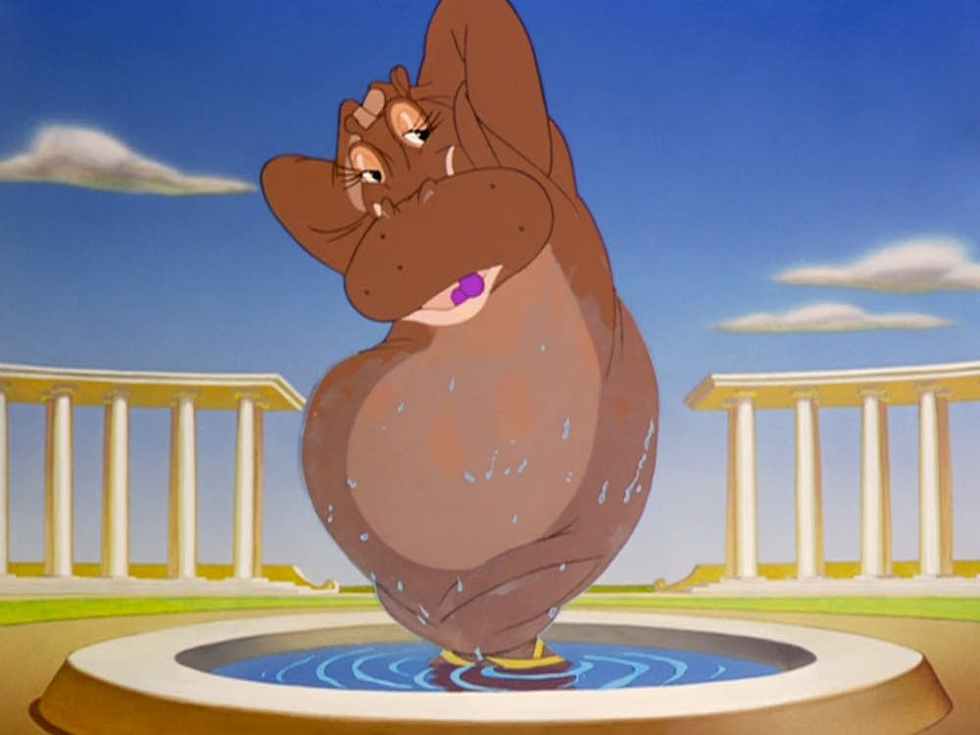
But, in all, the film is a weird phenomenon. Critics liked it, but it didn’t really click with broad audiences, despite the love the company had for the film and the earnestness with which Walt wanted the film to transform filmmaking. There was a real artistic, original goal, butts-in-seats be damned. It’s an exciting albeit confusing mish-mash of genre: animated film meets classical; compositional arrangement meets metaphor and interpretive dance meets Mickey Mouse.
After Fantasia’s monetary flop, Disney would release Dumbo in 1941, which was a box office hit and beloved by critics for its emotionality, but a film that Disney reportedly didn’t even want to make. Also in 1941, Disney’s animators would go on strike for four months for fair wages and better hours, delaying work on Bambi. That film flopped upon release in 1942, with the story viewed as too adult with visual metaphors and dark themes, and a lack of fantasy pushing critics and audiences away. As American companies turned their attention to contributing to the war effort, slowed down production and tightened belts, Disney focused on live-action, documentary films, which were less expensive, less laborious and majorly propagandized (and didn’t need strike-prone animators). Disney had quiet successes that we don’t really talk about today, like Fun and Fancy Free in 1947. Disney’s stature as an animation powerhouse wouldn’t return until 1950’s Cinderella (which still only cost a meager $30-40 million). Fantasia, in the 1940s, was a decrescendo.
FANTASIA: FOLIE À DEUX
Then, under the leadership of CEO Michael Eisner who began his tenure in 1984, the Walt Disney Company was riding high in its “Renaissance” era. The animation studio had a historic run: The Little Mermaid (1989), Beauty and the Beast (1991), Aladdin (1992), The Lion King (1994), Pocahontas (1995), The Hunchback of Notre Dame (1996), 101 Dalmatians (1996), Hercules (1997), Mulan (1998), Tarzan (1999), and Pixar’s first feature Toy Story (1995) then Toy Story 2 (1999).
Throughout these repeated successes, Eisner, alongside Roy Disney, Walt's nephew, wanted to make another Fantasia film. Jeffrey Katzenberg, the Walt Disney Animation Studios chairman at the time, thought it was a stupid idea and continued churning out moneymakers (see above). To Katzenberg, Fantasia had a coming-and-going position in culture. It had semi-successful albeit short re-releases, and niche interest group fixations kept the film in the rolodex of cultural topics, but the film was a commercial failure, and it wasn’t like Disney needed a second Fantasia to spur on the innovation of animation - Disney was already doing that with their other animated titles - and no one else was asking for a second Fantasia.

It wasn’t until successive home video releases re-elevated the film and kick started forward motion on a new Fantasia project. In 1992, Fantasia became the best selling cassette of all time in the US with 14.2 million copies purchased (until Beauty and the Beast’s tape beat that record). From 1990 to 1994, over 21.7 million video copies of Fantasia were sold worldwide. Seems like with this renewed fervor, Eisenberg and Roy Disney could finally convince Katzenberg to kickstart a new Fantasia, titled Fantasia 2000.
Like its older sister, Fantasia 2000 featured eight animated segments, each set to Beethoven, Gershwin, Dukas, Stravinsky (karma) and others, and included a restored The Sorcerer’s Apprentice bit. The film also featured the popular character Donald Duck (and his girlfriend-wife Daisy); as learned from Fantasia, one Disney character wasn’t enough for parents/general audiences to see the movie as Disney film. Donald was cast as an assitant to Noah (of the Genesis variety), ushering animals two-by-two onto The Ark. The implications of that image - an American corporation actively imagining one of its core products alongside a Biblical, Christian figure - are unfathomable today, but it was necessary to have another familiar, highly comedic character in use to break up the classical aesthetic tone of the film.
But it seems like that was the only lesson learned as Disney sent Fantasia 2000 on a limited world concert tour across seven cities. Each performance cost $1 million to produce.
Fantasia 2000 was opened with IMAX surround sound on January 1, 2000, the first animated feature to be released in that format, grossing $65 million. The film didn’t expand wide until June that year and stumbled at the box office. By the time its initial run was over, the film grossed nearly $91 million worldwide, about what the film cost.

Fantasia 2000 was called Roy’s Folly (by Eisner, no less).
After 1999, the studio went through duds. In 2001, the company announced 4,000 layoffs. Eisner would be ousted in 2004.
Maybe it’s the audience's taste that stunted the film. Fantasia 2000 was, for a short time, intended to be set to music by The Beatles. Maybe that would’ve interested the '00s public a little more than classical concertos, and maybe there’s a reason high and “low” art are separated.
Maybe it’s the lack of known characters, besides Donald and Mickey. Sure, they’re pretty monolithic, but Disney was in princess mode, very successfully. Would Ariel swimming alongside the whales featured in the Pines of Rome segment have boosted interest?
Further, critics, who were the championing audience of the first film, were lukewarm on Fantasia 2000. The tone was still too adult and segments seemed out of place. Empire says that, though gorgeous to look at, the film "hardly justifies the 60-year wait." Stephen Holden of The New York Times wrote that the film "often has the feel of a giant corporate promotion whose stars are there simply to hawk the company's wares" while noting the film "is not especially innovative in its look or subject matter."
I think that’s a fair assessment. Nearly 10 years prior to Fantasia 2000’s release, Beauty and the Beast had transformed what animation could look like, how the camera could move, and what simulated lighting could express. That’s not to say Fantasia 2000 hadn’t earned its own cinematic achievements: The Carnival of the Animals, Finale, which featured yo-yoing flamingos, used 6,000 watercolor backgrounds; Rhapsody in Blue, a gorgeous monochromatic blue sequence, is as expressive and near American camp as Disney ever got. Additionally, Fantasia 2000 was a building block for CGI animation technology that would be the birth of tools used to animate the gorgeous snowflakes in Frozen and the graceful movements of light in Tangled.

But the overall result, while stuffed, isn’t a satisfying bite, perhaps because the film feels only like a building block, a blueprint of something special. Though each segment is significantly more narrative and linear than the stories in Fantasia, there aren’t interconnected themes throughout the anthology, no overarching motifs of good versus evil, no symbolic presentations of animals, the Earth, or mythological figures. While the original had a cohesive poetic language, Fantasia 2000 presents as a myriad of differing voices all telling you something near impossible, or pointless, to understand. You kind of shrug afterwards. It looked good, but gosh, remember Beauty and the Beast?!
Walt wanted to change animation, alter the perception of the company, and challenge the culture of moviegoing by mixing high and “low” art. Eisner didn’t need to show off the company’s animation chops, especially not by 1999; he was happy with the company’s top position as kids’ content producer; and he was reasonably motivated solely by the financial success of the home video release to create a sequel.
I struggle with calling Fantasia 2000 a folly or, worse, a flop. The film exists both as a capitalist cash grab and a unique, arts-as-innovation testament. It wasn’t an assured butts-in-seats hit, and it was made anyways, which feels rare, especially today. Maybe it was the intention behind Fantasia 2000 that doomed it.
Money can’t be the only justification for making or not making a sequel, rebooting or not rebooting a franchise, especially in an industry that has a mission to be creative and innovative, even if a 100th sequel to Final Destination feels antithetical to that commandment. Maybe no one besides Roy Disney was really asking for a Fantasia sequel, but maybe more people should have been. If we ask for a third Fantasia, what astounding possibilities could it provide for animation 10 years in the future, despite the money it won’t make?


Comments